
Corporate Language Training: The Strategy That Builds Stronger Teams
Last updated: March 2026. Original post: December 2024.
Language barriers are one of the most expensive and least visible problems in American workplaces. According to Grammarly's 2024 State of Business Communication report, miscommunication costs U.S. businesses $1.2 trillion annually, translating to roughly $12,506 per employee per year in lost productivity. For organizations with multilingual workforces, a significant share of that cost is tied directly to language gaps.
The effects go beyond productivity. Research from Relay's 2024 survey found that 86% of respondents believe their workplace loses productivity due to language barriers, with bilingual employees spending an average of four hours per week translating for colleagues at a cost of $7,500 annually per bilingual worker in lost output. OSHA estimates that language-related miscommunication contributes to 25% of workplace accidents. And when it comes to retention, language barriers contribute to turnover that costs companies between 50 and 75% of an employee's annual salary per replacement.
Corporate language training addresses all of it. Not as a perk or a one-time workshop, but as a sustained investment in how your teams communicate, collaborate, and grow together. This post walks through what the research says, why language training outperforms traditional team-building approaches, and how it connects to your organization's DEI goals.
Why Language Training Outlasts One-Off Team Building
Most team-building investments deliver a short-term lift. A retreat, an escape room, a company lunch — these create a temporary sense of connection, but their effects rarely extend into the day-to-day dynamics of how a team actually works. Research from Forbes confirms that while one-off activities can boost morale in the moment, they do not address deeper issues like chronic miscommunication, distrust, or employees feeling disconnected or undervalued.¹
Corporate language training operates differently. It is a long-term, skills-based investment that builds something durable. Teams learn together over time, develop shared vocabulary and communication practices, and develop interpersonal trust through a process that asks them to be patient with one another, correct one another, and celebrate progress together. LinkedIn's 2024 Workplace Learning Report identified providing learning opportunities as the top strategy for retaining employees, and language training sits squarely in that category.
The investment is also measurable. A well-executed corporate language program delivers returns in reduced miscommunication costs, improved safety compliance, stronger team cohesion, and lower turnover. According to research from Perply, a strong language training program can deliver ROI above 100%.
The Business Case for Shared Learning Experiences
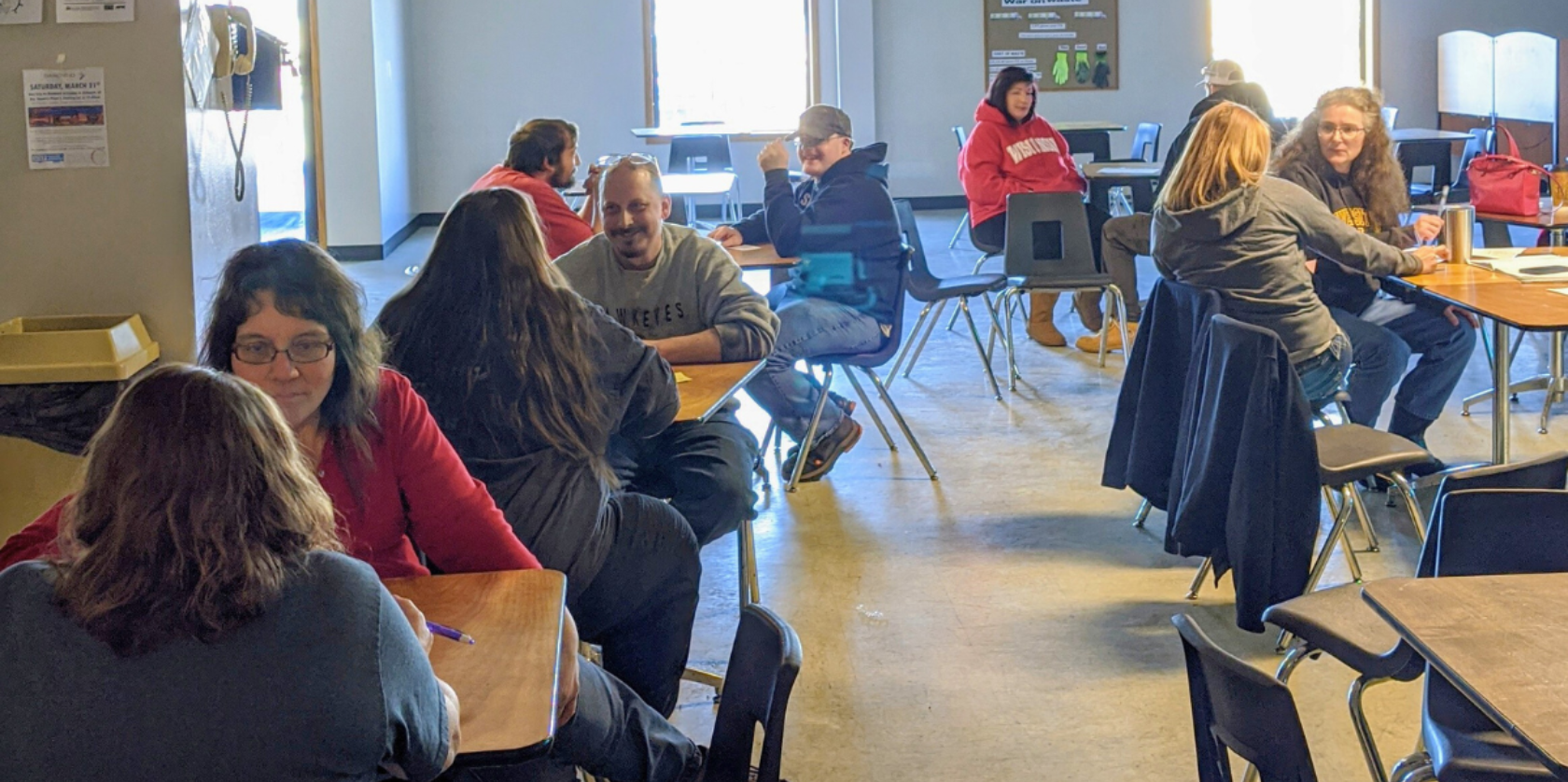
There is a meaningful difference between employees attending the same training and employees learning together. Research from Yale University demonstrates that people feel a greater sense of connection when they engage in the same experience, regardless of whether they actively interact during it.² When that shared experience involves something as immersive as language learning, the effect is amplified.
Language learning requires vulnerability. Employees practice in front of colleagues, make mistakes, ask for help, and support one another through a process that is genuinely challenging. According to the Clark Relationship Lab study, this collaborative experience builds trust and deeper relationships within teams, and that trust translates directly into better performance on the job.²
When employees from different departments learn together, the benefits extend beyond the language itself. They build relationships outside their usual professional circles, break down silos, and develop a foundation for cross-departmental collaboration that persists long after the program ends. Research from Indeed confirms that a connected employee experience leads to measurably better engagement and productivity.³
As noted in Strategy+Business, adding elements of shared, enjoyable experience to the workday brings teams closer, lowers stress, and creates an environment where creative thinking is more likely to flourish.⁴ Language training delivers all of that while also producing a tangible, career-relevant skill.
Stronger Communication Starts With the 6 C's
Trust is the foundation of any high-performing team, and trust is built through consistent, honest communication. CMOE identifies six qualities that effective team leaders demonstrate: character, caring, competence, consistency, credibility, and communication.⁵ Corporate language training develops all six simultaneously.
Character develops through commitment to the learning process.
Caring shows up when team members support one another through difficult lessons.
Competence grows as employees build a new, practical skill.
Consistency is reinforced through regular practice.
Credibility builds as employees see one another showing up and improving. And communication, the outcome everyone is working toward, improves both in the target language and in how the team interacts overall.
Language Training as a Concrete DEI Investment
DEI initiatives often stall at the level of intention. Organizations commit to inclusive cultures but struggle to identify investments that produce measurable, lasting change. Corporate language training is one of the clearest exceptions.
When employees face language barriers, the consequences are not evenly distributed. Non-native speakers are less likely to speak up in meetings, less likely to be considered for leadership roles, and more likely to feel isolated from the broader team. SHRM (2023) emphasizes that successful DEI initiatives must actively remove these barriers rather than simply acknowledge them.¹ Language programs create the conditions for every voice to be heard.
The connection to belonging is direct. Korn Ferry (2023) found that a culture of belonging not only improves employee satisfaction but also boosts performance by encouraging employees to bring their full selves to work.² When team members feel supported in developing language skills, they feel valued. That sense of being valued is a driver of both engagement and retention.
Career equity is another dimension that language training addresses in practice. Penn's DEI workplace report (2023) highlights how training initiatives are essential for ensuring fair access to advancement opportunities for underrepresented groups.³ Employees who face language barriers often face a glass ceiling that has nothing to do with their capability. Language training removes that barrier in a way that generic DEI programming cannot.
For a closer look at the business case for bilingual talent, see why bilingual employees are a high-impact business asset.
McKinsey's research adds a financial dimension: enterprises with racially and ethnically diverse leadership have a 36% advantage in achieving financial outperformance. Diverse perspectives drive better decisions, but only when people can express those perspectives clearly. Language training is what makes diverse teams as effective as they are diverse.
TeamBonding (2023) puts it plainly: inclusive cultures are not built through statements, they are built through environments where diverse perspectives can be shared freely.⁴ Corporate language programs create those environments. BetterWorks (2023) reinforces that strategic DEI investments are essential for long-term organizational reputation and success.⁵ Offering language training signals to every employee that the organization is serious about inclusion, not just committed to it in principle.
Download our free Corporate Language Training guide and checklist to see exactly what a well-designed program looks like, what questions to ask a provider, and how to make the case internally for the investment.
How to Get Started With Corporate Language Training
The most effective corporate language programs share a few common characteristics. They are built around the specific communication needs of the organization rather than a generic curriculum. They bring employees together to learn in groups rather than relegating learning to solo app-based study. And they are sustained over time rather than delivered as a one-time event.
A few practical starting points:
Assess your team's specific language needs before selecting a program. The right focus for a manufacturing team is different from what a healthcare organization or professional services firm needs.
Prioritize group learning over individual study. The team-building benefits of language training come from learning together, not from everyone studying independently at their own pace.
Set shared milestones and celebrate progress publicly. Recognizing achievements keeps motivation high and reinforces the sense of shared purpose.
Create opportunities to practice in real contexts. Language-themed team lunches, role-play scenarios drawn from actual work situations, or volunteer opportunities where employees use new skills all accelerate progress.
Measure outcomes. Track changes in communication incidents, employee satisfaction scores, and retention data. Language training is an investment with measurable returns, and treating it that way helps make the case for continued funding.
Organizations that integrate language training into their ongoing development strategy, rather than treating it as a one-off initiative, see the strongest and most lasting results.
How Inspired Language Solutions Supports Your Team
Inspired Language Solutions offers customized Spanish and English language training for organizations in Madison, WI and beyond. Programs are built around your team's specific goals, whether that means improving frontline safety communication, supporting a bilingual workforce, or equipping your leadership team to work more effectively across language lines.
Every program is developed and led by Ramona Field, with over a decade of experience in language education and a track record of building programs that produce real results for real teams. If you are ready to explore what corporate language training could look like for your organization, the first step is a conversation.
If you are making the case internally for language training as an employee benefit, this post on language instruction as a high-impact workforce investment walks through the ROI.
Ready to invest in your team's communication and cohesion? Let's talk about what a customized language training program could look like for your organization. The first step is a free 30-minute discovery call.
Learn more about our Corporate Language Training services or explore how Camino Español supports individual learners.
Forbes. (2016, March 9). Why team building is the most important investment you'll make. https://www.forbes.com/sites/brianscudamore/2016/03/09/why-team-building-is-the-most-important-investment-youll-make
Boothby, E. J., Clark, M. S., & Bargh, J. A. (2014). Shared experiences are amplified. Psychological Science, 25(12), 2209-2216. https://doi.org/10.1177/0956797614551162 / Clark Relationship Lab study via TeamBonding. https://www.teambonding.com/shared-learning-experiences
Indeed. (n.d.). How to create a connected employee experience. https://www.indeed.com/hire/c/info/how-to-create-connected-employee-experience
Strategy+Business. (2022). The serious fun of shared experiences at work. https://www.strategy-business.com/blog/The-Serious-Fun-of-Shared-Experiences-at-Work
CMOE. (n.d.). Optimal teamwork: Leaders build trust with the 6 C's. https://cmoe.com/blog/optimal-teamwork-leaders-build-trust-6-cs
SHRM. (2023). How to develop an inclusion and diversity initiative. https://www.shrm.org/topics-tools/tools/how-to-guides/how-to-develop-an-inclusion-diversity-initiative
Korn Ferry. (2023). 6 steps to increase diversity and inclusion in the workplace. https://www.kornferry.com/insights/featured-topics/diversity-equity-inclusion/6-steps-to-increase-diversity-and-inclusion-in-the-workplace
University of Pennsylvania. (2023). DEI in the workplace: Why it's important for company culture. https://lpsonline.sas.upenn.edu/features/dei-workplace-why-its-important-company-culture
TeamBonding. (2023). How to create an inclusive culture at work. https://www.teambonding.com/inclusive-culture-at-work/
BetterWorks. (2023). Diversity and inclusion strategies. https://www.betterworks.com/magazine/diversity-and-inclusion-strategies/
Grammarly. (2024). State of Business Communication. Via weavix.com: https://weavix.com/blogs/barriers-workplace-communications/
Relay. (2024). The Hidden Costs of Language Barriers in Industrial Settings. https://relaypro.com/blog/hidden-costs-of-language-barriers-in-industrial/
LinkedIn. (2024). Workplace Learning Report. Via trainingorchestra.com: https://trainingorchestra.com/employee-training-trends/
McKinsey & Company. Diversity wins: How inclusion matters. Via market-inspector.co.uk: https://www.market-inspector.co.uk/communication-in-the-workplace
Perply. Language training ROI. Via edstellar.com: https://www.edstellar.com/blog/corporate-language-trainin