
Camino Español vs Traditional Spanish Classes
Camino Español vs Traditional Spanish Classes: Which One Fits Your Life?
If you are weighing Camino Español against a traditional Spanish class, you are probably past the app stage. You know you want structure. You know you want an actual instructor. The question is what kind of learning environment actually works for the life you have right now.
This page breaks down both options honestly so you can make the right call for where you are.
Quick Verdict
Traditional Spanish classes are the better choice if you thrive in a structured classroom environment with a fixed schedule and enjoy learning alongside a cohort of students at the same pace. Camino Español is the better choice if you are a busy adult who needs flexibility, wants to learn at your own pace, and is looking for live conversation practice and a community beyond the classroom walls. For most working adults, the schedule and pace of a traditional class is the biggest obstacle. Camino Español is built around removing that obstacle.
What Are Traditional Spanish Classes?
Traditional Spanish classes are instructor-led courses that follow a fixed schedule, typically meeting once or twice a week for a semester or term. They may be offered through community colleges, adult education programs, language schools, or private tutors. Classes are usually structured around a shared curriculum where all students progress at the same pace, with grades, homework, and assessments along the way.
The format has been the standard approach to language learning for decades. For the right learner, it works well. A committed student who can attend every session, keep up with the pace, and thrive in a classroom environment can make solid progress. The challenge for most adult learners is that life tends to get in the way of that commitment.
What Is Camino Español?
Camino Español is an online Spanish membership for adults, created by Ramona Field of Inspired Language Solutions. Ramona spent over a decade teaching Spanish in public schools before building a program specifically for adult learners who need something more flexible and more connected than a traditional class can offer.
The membership includes six Spanish Segments from beginner to advanced, four live community events every month, a membership community where learners connect and practice between sessions, and direct access to Ramona for questions and support. Courses are self-paced with no deadlines, so you move through the material at the speed that works for you. Live events give you structured conversation practice every month without requiring you to show up at the same time every week.
Membership is $65 per month or $780 per year, month to month with no minimum commitment. You can pause or cancel at any time. Private one-on-one classes with Ramona are available to members at $35 per session. A free one-month trial is currently available for new members.
What Traditional Spanish Classes Cost
Cost is one of the most significant differences between the two options, and it is often underestimated when people compare them.
Private Spanish tutoring runs between $25 and $50 per hour for one-on-one instruction, according to multiple tutoring platforms. At two sessions per week, that is $200 to $400 per month for lessons alone, with no curriculum, no community, and no additional practice resources included.
Group classes at language schools or adult education centers typically cost $10 to $25 per student per hour. A standard weekly class over a semester adds up quickly, often running $300 to $600 for the term, sometimes more depending on materials and enrollment fees.
Camino Español at $65 per month includes six structured Spanish Segment courses, four live events every month, a membership community, direct instructor access, and the ability to add private sessions at $35 each. On an annual basis, that is $780 for everything, compared to $2,400 to $4,800 for comparable private tutoring at the lower end of the market rate.
Private tutoring cost data sourced from tutors.com, 2025
Camino Español vs Traditional Classes: Side by Side
| Feature | Camino Español | Traditional Classes |
|---|---|---|
| Monthly Cost | $65/month or $780/year | $120 to $400+/month depending on frequency and format |
| Schedule | Fully flexible. Learn on your own schedule with live events you opt into. | Fixed class times. Miss a session and you miss the material. |
| Pace | Self-paced courses. Move faster or slower based on your progress. | One pace for everyone in the class regardless of level. |
| Live Instruction | 4 live events every month plus direct access to Ramona. | Weekly or bi-weekly classes depending on enrollment. |
| Community | Active membership community. Practice between sessions with other learners. | Limited to classmates. No ongoing practice outside class time. |
| Instructor Access | Direct messaging with Ramona. Private classes at $35/session. | Varies. Often limited to class time only. |
| Curriculum | 6 Segments, beginner to advanced. Clear progression with defined outcomes. | Varies by program. Quality and structure differ widely. |
| Commitment | Month to month. Pause or cancel any time. | Semester or term enrollment. Often non-refundable after start date. |
| Best For | Adults who need flexibility, structure, and ongoing practice with a community. | Learners who thrive in a classroom setting with a fixed schedule. |
Where Traditional Classes Have the Advantage
The classroom environment works for some learners
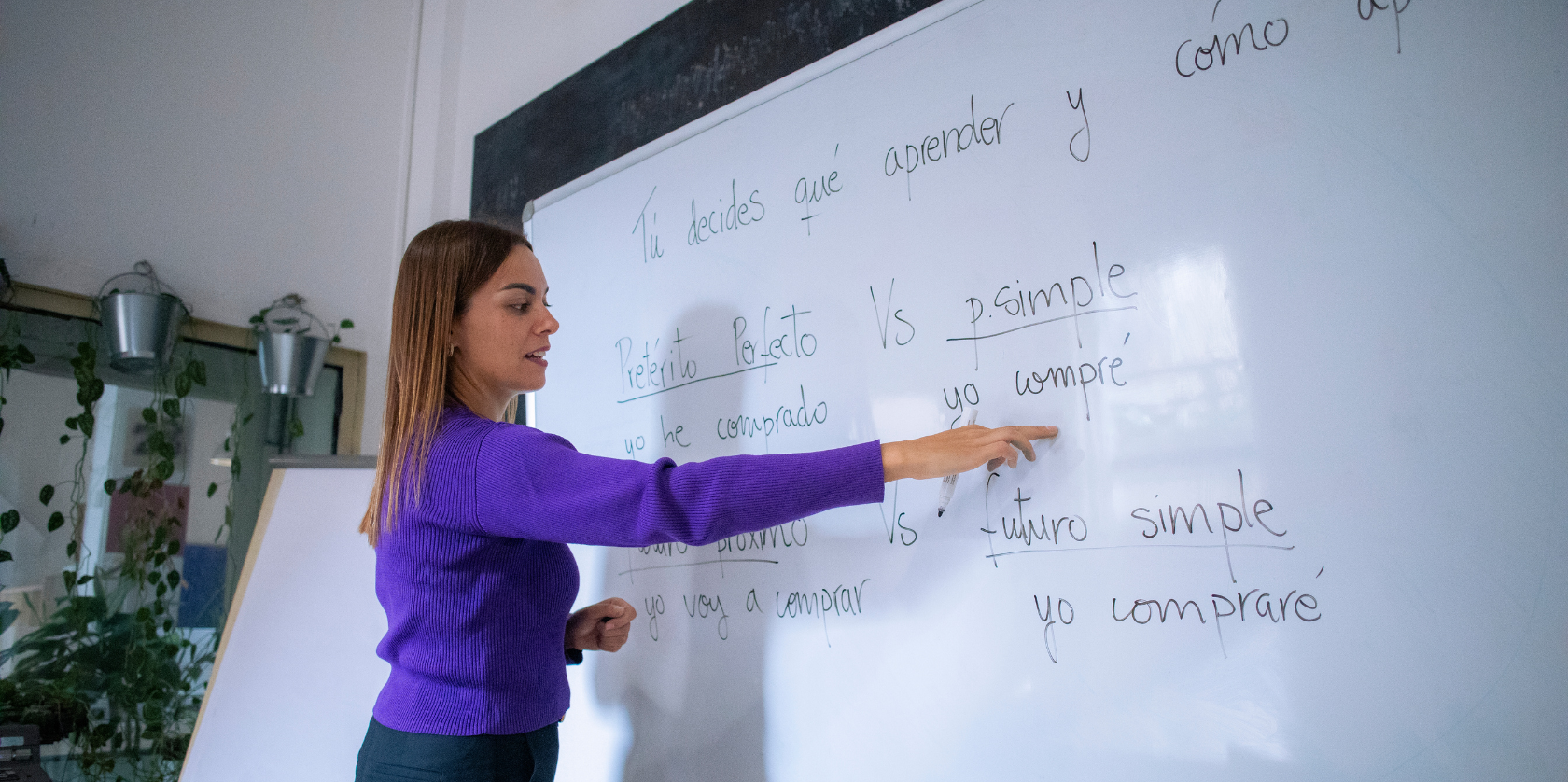
Some adults genuinely learn better in a room with other people, a whiteboard, and a teacher standing at the front. The social pressure of showing up, the accountability of a grade, and the structure of a syllabus are real benefits for learners who thrive in that environment. If that describes you, a traditional class may serve you better than a self-paced online membership.
A fixed schedule can create consistency
For learners who struggle with self-direction, a mandatory weekly class can be the structure that keeps them moving. Knowing you have to show up on Tuesday at 7pm is a commitment device that some people need. Camino Español requires you to manage your own schedule, which is a strength for some learners and a challenge for others.
Credentials and formal assessment
If you need a grade, a transcript, or a formal language certification for academic or professional purposes, a traditional class or accredited program provides that. Camino Español is a membership learning community, not an accredited course. If credentials matter for your situation, that is a meaningful distinction.
Where Camino Español Has the Advantage
It fits around your life, not the other way around
Traditional classes have a fixed schedule. If you travel for work, have children, or work unpredictable hours, missing a class means missing the material and falling behind a group that keeps moving without you. Camino Español courses are self-paced. You do the coursework when you can, and the live events are monthly rather than weekly, which means missing one does not derail your progress.
You are not stuck at one pace
In a traditional class, the group moves together. If you already know the basics, you sit through material you have covered. If you are struggling with a concept, the class moves on before you are ready. Camino Español lets you move through the six Segments at the speed that matches where you actually are, without waiting for anyone or being left behind.
The cost is significantly lower
Private tutoring at market rates runs $200 to $400 per month for lessons alone. Camino Español at $65 per month includes structured courses across six levels, four live events, community access, and direct instructor contact. If you want private sessions, they are available at $35 each as an add-on, not a baseline requirement.
Practice does not stop between sessions
One of the most common reasons adult learners plateau in traditional classes is that the learning happens twice a week and then stops. There is no community to practice with, no events to attend, and no structure between sessions. Camino Español has a live community space and four monthly events that keep practice happening between course modules. Language acquisition requires consistent exposure, and the membership is built around providing it.
You have a direct relationship with your instructor
In a group class, your instructor is managing an entire room. Questions get answered briefly, feedback is general, and personalized attention is limited by the size of the group. In Camino Español, you can reach Ramona directly through the community platform, and private sessions are available at $35 when you want focused individual support on a specific challenge.
Which One Is Right for You?
Choose a traditional class if:
You learn best in a structured classroom environment with a fixed weekly schedule
You need a grade, transcript, or formal credential for academic or professional reasons
You prefer learning in a cohort at a consistent pace alongside other students
You have a predictable schedule with no travel or irregular hours
Self-directed learning feels difficult and you need external accountability to stay consistent
Choose Camino Español if:
You have tried classes before but life kept getting in the way of a fixed schedule
You want to move at your own pace through a structured curriculum
You are looking for ongoing practice with a community, not just weekly class time
You want direct access to an instructor without paying private tutor rates
You need month-to-month flexibility with no long-term commitment
Cost matters and you want maximum value for what you spend on learning
Ready to Learn Spanish on Your Terms?
If the schedule and pace of a traditional class have held you back before, Camino Español is built for exactly that situation. Six structured Spanish Segments, four live events every month, a community to practice with, and an instructor you can actually reach.
Month to month. No minimum commitment. Try it free for one month.
You might also be interested in:
Explore Camino Español | Meet Ramona | Camino Español vs Duolingo | Camino Español vs Babbel